Cable and connector types
Compare copper and fibre, their connectors and the distances they can reach.
Cable choice affects reach, speed and cost. CCNA 1.3 covers copper, single-mode fibre and multimode fibre.
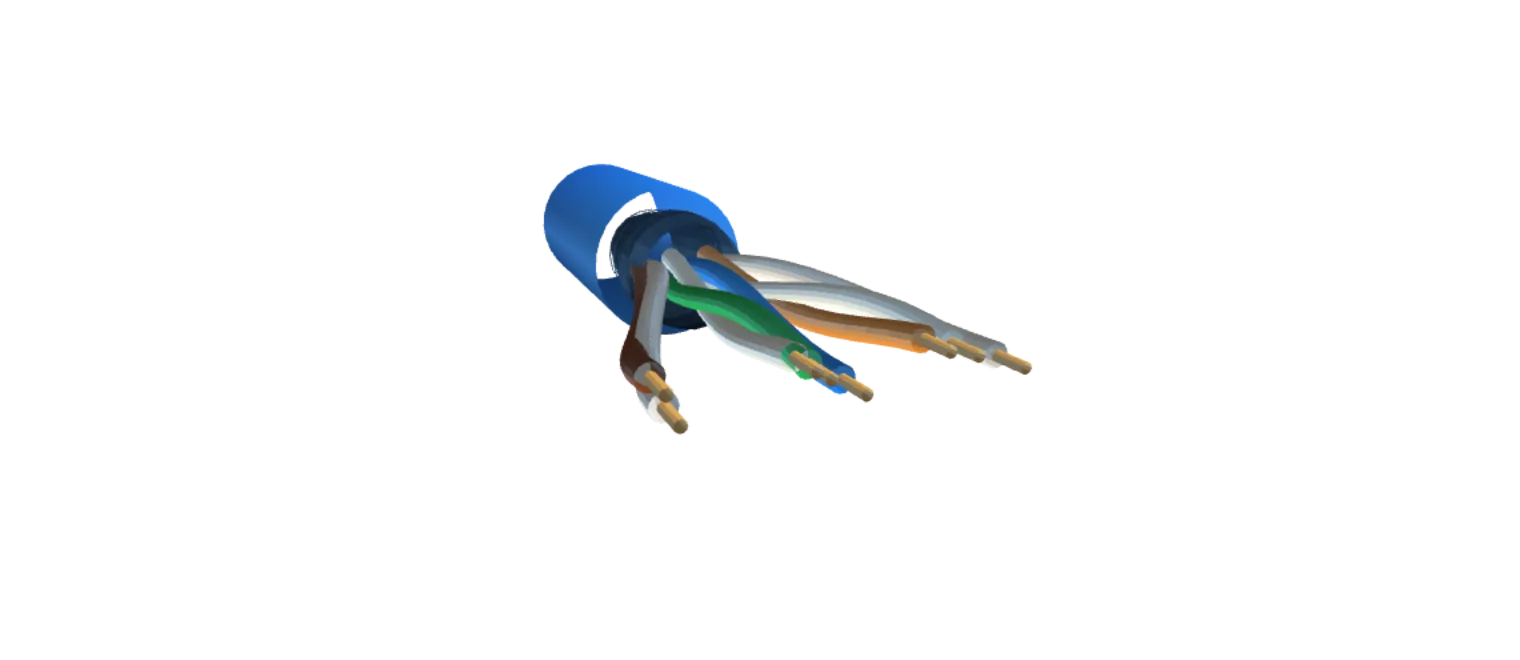
Copper: RJ45 and twisted pair
| Grade | Speed and reach | Channel limit |
|---|---|---|
| Cat5e | 1 Gbps to 100 m | 100 m |
| Cat6 | 1 Gbps to 100 m, 10 Gbps only to about 37 to 55 m (depends on crosstalk) | 100 m |
| Cat6a | 10 Gbps to 100 m | 100 m |
Straight-through cables connect unlike devices, while crossover cables connect like devices.
Auto-MDIX allows either cable to work on modern gear.
Connectors you will meet
Explore the connectors used with copper and fibre cables.
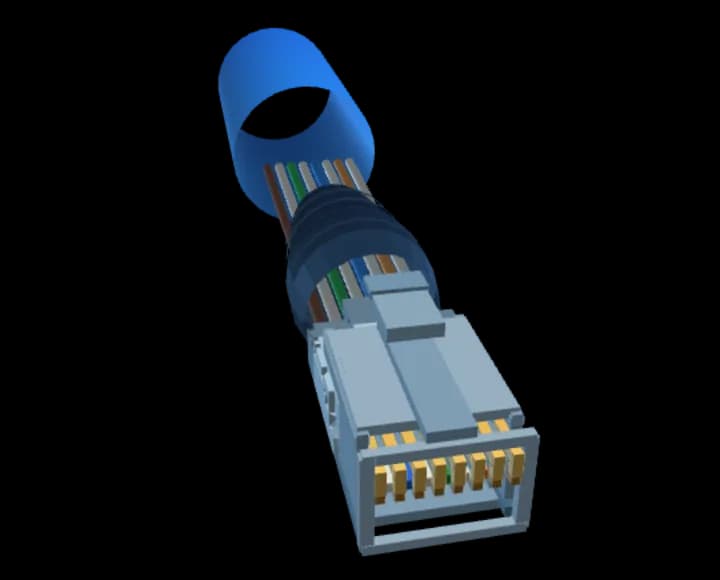
10 and 100 Mbps: 10BASE-T and 100BASE-TX use two pairs: on a PC (MDI) pins 1-2 transmit and 3-6 receive; a switch port (MDI-X) does the reverse. Pins 4, 5, 7 and 8 sit idle.
- Medium
- Copper
- Contact
- 8 gold-plated contacts
- Locks by
- Latch
Where you will meet it
Access ports, patch cables, PoE devices, Cat5e to Cat6a. Pick a speed or PoE type under the plug to see which pins it uses.
For the exam
Straight-through cables join unlike devices, crossover cables join like devices. Auto-MDIX makes either work on modern gear.
Ferrule size, to scale
RJ45 has no ferrule: its gold-plated contacts pierce the copper wires when crimped.
RJ45 is copper, while LC, SC and ST are fibre connectors. LC is the small one used on optics in SFP ports.
Why fibre has two kinds
Single-mode fibre has a tiny 9 µm core, so light can only take one straight path down it. That keeps the signal sharp over many kilometres, but it needs a precise laser, which makes the optics cost more.
Multimode fibre has a much wider 50 µm core (62.5 µm on old OM1), so light bounces along many paths at once. The paths arrive at slightly different times and smear the signal (modal dispersion), which limits 10 Gbps and faster multimode links to a few hundred metres. In return it works with cheap 850 nm VCSEL optics, so it is the usual choice inside a building or data centre.
Follow the light down the fibre
The core carries almost all of the light. Its width is the main thing that decides how many paths the light can take.
Many paths means the pulses arrive at slightly different times, so they smear together. That modal dispersion is why multimode is limited to hundreds of metres. It pairs with cheap 850 nm LED or VCSEL light sources.
Fibre grades compared
| Grade | Core / cladding | Jacket | Reach and use |
|---|---|---|---|
| OM1 | 62.5/125 µm | Orange | 1G 275 m, 10G 33 m, 40/100G not supported |
| OM2 | 50/125 µm | Orange | 1G 550 m, 10G 82 m |
| OM3 | 50/125 µm, laser-optimised | Aqua | 10G 300 m, 40G-SR4 100 m, 100G-SR4 70 m |
| OM4 | 50/125 µm | Aqua (some vendors use violet) | 10G 400 m, 40G-SR4 150 m, 100G-SR4 100 m |
| OS1 | 9/125 µm | Yellow | Usually tight-buffered indoor fibre, up to 10 km typical, attenuation about 1.0 dB/km |
| OS2 | 9/125 µm | Yellow | Usually loose-tube outdoor and long-haul fibre, 10 km to 200 km depending on optics, attenuation about 0.4 dB/km |
Reach is set by the optics and the fibre together. Single-mode reach depends on the transceiver: 10GBASE-LR reaches 10 km, ER 40 km and ZR 80 km.
Cisco 10G optics: SR, LR and the -S versions
A Cisco 10G module is a small transceiver that plugs into a switch port and turns the electrical signal into light. Strictly it is an SFP+ (the 10 Gbps version of the SFP slot), though Cisco part numbers just say SFP-10G. The module decides the fibre type and the reach. The SR and LR modules below use a duplex LC: one fibre to transmit, one to receive.
SR: short reach on multimode
SFP-10G-SR (10GBASE-SR) uses an 850 nm laser over multimode fibre. It reaches 300 m on OM3 and 400 m on OM4, but only 33 m on old orange OM1. It is the usual choice for switch to server and switch to switch links inside a data centre or comms room.
LR: long reach on single-mode
SFP-10G-LR (10GBASE-LR) uses a 1310 nm laser over single-mode fibre and is rated for 10 km, provided the total fibre and connector loss stays within the optic's budget. Pick it when the link leaves the building or runs further than multimode allows. Beyond 10 km you move to ER (40 km) or Cisco's ZR (80 km, a vendor optic rather than an IEEE standard).
What the -S means
SFP-10G-SR-S and SFP-10G-LR-S are Cisco's S-Class versions. They have the same optical specifications (wavelength, fibre and reach) but support Ethernet only, with no FCoE, and are positioned as the lower-cost option. That is all most campus and enterprise switches need.
| Module | Wavelength | Fibre | Reach | Typical use |
|---|---|---|---|---|
| SFP-10G-SR | 850 nm | Multimode (OM3, OM4) | 300 m on OM3, 400 m on OM4 | Server to switch, switch to switch in the same room |
| SFP-10G-SR-S | 850 nm | Multimode (OM3, OM4) | 300 m on OM3, 400 m on OM4 | Same as SR, Ethernet only, lower cost |
| SFP-10G-LR | 1310 nm | Single-mode (OS1, OS2) | 10 km | Between buildings, campus backbones |
| SFP-10G-LR-S | 1310 nm | Single-mode (OS1, OS2) | 10 km | Same as LR, Ethernet only, lower cost |
How to choose
- Fibre already in the wall: of the two shown here, multimode (orange or aqua jacket) takes SR and single-mode (yellow) takes LR. An SR module will not work over single-mode, and the other way round.
- Distance: under about 300 m on OM3 or 400 m on OM4, SR is cheaper. Further than that, LR.
- Both ends match: an SR at one end needs an SR at the other. You cannot mix SR and LR on one link.
- The switch supports it: check Cisco's transceiver compatibility matrix for the exact switch and software version. Once it is in,
show interfaces transceivershows the light levels andshow inventoryshows the module type.
If the module is right and the link still stays down, swap the transmit and receive fibres at one end, as covered in the LC section above.
What about OC-1, OC-3?
OC-1 is 51.84 Mbps and OC-3 is 155.52 Mbps. These are SONET optical carrier line rates, not cable types. They ride on single-mode fibre (typically OS2). The cable grades are OM1 to OM4 and OS1/OS2.
Which one should I use?
- Patch cable to a PC or AP: Cat6 or Cat6a with RJ45.
- Server to switch in the same rack or row: OM3 or OM4 multimode with LC and SFP+.
- Between buildings or beyond about 400 m: OS2 single-mode with LC.
- Legacy gear: SC or ST patch cords.
Keep learning
Continue with SFP transceivers and network modules or subnetting explained.